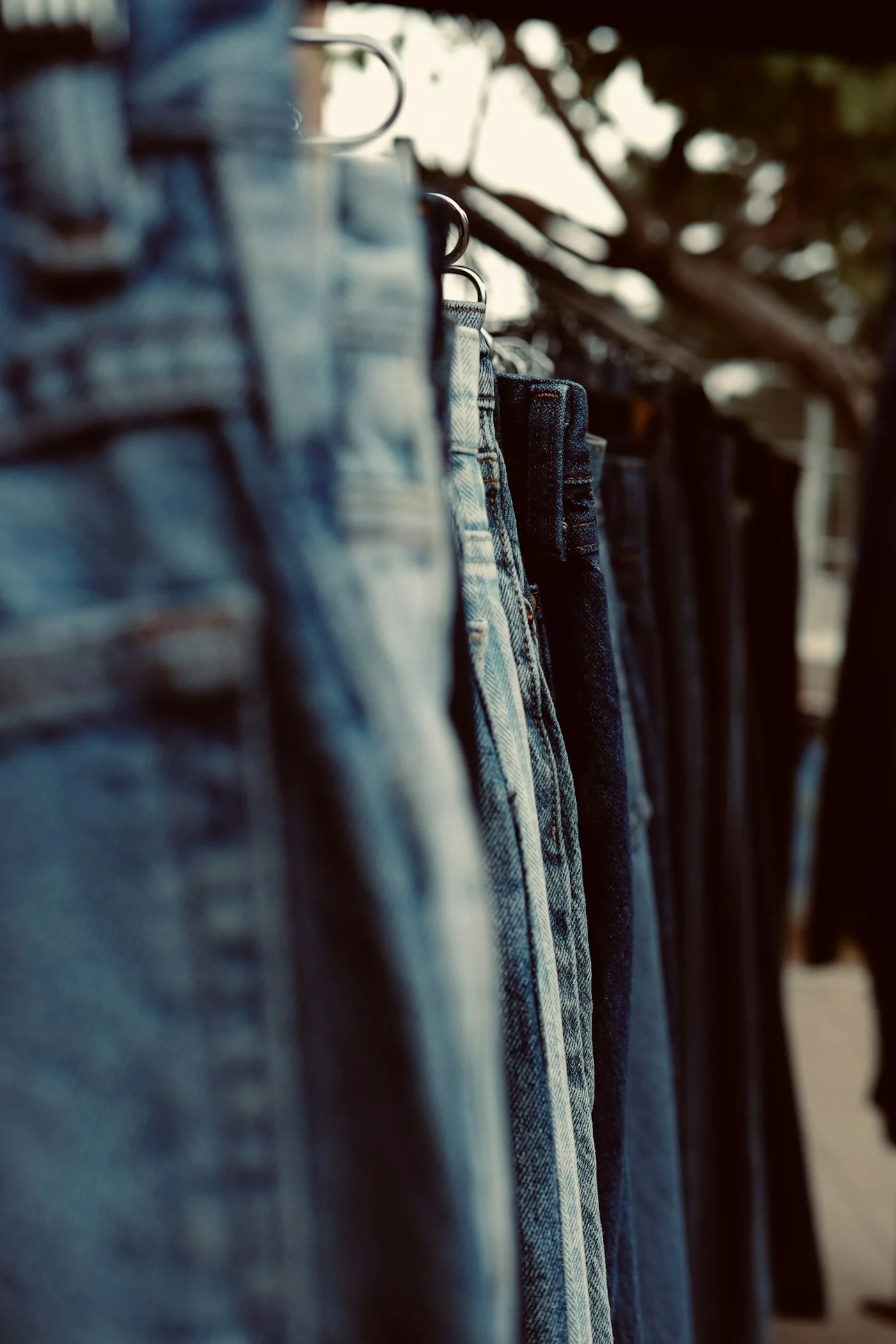
Denim is familiar enough that its construction can disappear behind the word jeans. Yet a dark rigid pair, a lightweight denim shirt and a stretch trouser can differ in yarn, weave, weight and finishing. Their shared appearance does not make their care or repair requirements identical.
Look at the fabric from both sides and read the composition before drawing conclusions. A few structural clues explain much of the characteristic appearance, while the finished garment supplies the information those clues cannot reveal. Include pockets, seams and areas under repeated strain in that inspection; a strong-looking main panel cannot establish the condition of every component.
Begin with the diagonal structure
Denim commonly uses a twill construction, with a diagonal line created by the advancing yarn interlacings. CottonWorks' denim and weaving guides explain how different twill arrangements change the fabric face and the proportions of yarn shown.
Look at a sound area rather than a heavily distressed patch. Follow the diagonal without stretching or pulling yarns out. A printed diagonal can imitate a visual effect, so use the product description where structure is difficult to see.
Twill is a broad family, not a synonym for denim. Other cloth can share the diagonal structure while using different yarns, color arrangements and finishing. The name denim brings several construction choices together rather than identifying every twill fabric.
Compare face and reverse
A familiar blue-denim construction emphasizes colored warp yarns on the face and lighter filling yarns on the reverse. That contrast helps explain the appearance at folded cuffs, worn areas and some seam details.
It is not a requirement that every product called denim reproduce the same color contrast. Yarns, dyes and finishing can vary. Read an actual specification rather than rejecting an unfamiliar version simply because its reverse is less pale.
Abrasion can change what the surface reveals, but an attractive worn look does not establish remaining strength. Inspect the cloth around a pale or distressed area before assuming it is merely a cosmetic effect.
Yarn size and arrangement change the cloth
A denim specification may list yarn size separately from finished fabric weight. CottonWorks explains cotton count using the number of 840-yard hanks in a pound of yarn. In this indirect system, a larger count means a finer yarn, rather than a heavier strand.
For an arithmetic example, a six-single cotton-count yarn gives six such hanks, or 5,040 yards per pound. A listing using another count system cannot be compared by the bare numeral. Ask which system is used and whether the specification refers to the warp, the filling or both.
This is not a home method for predicting garment strength. A count describes yarn; fabric weight also depends on construction and density, while finishes affect the handle. Compare two jeans using the complete specification, then inspect bending, bulk and fit rather than deciding that the lowest count must be the longest-lasting pair.
Stretch needs its own questions
Some denim includes elastic fibers, while other constructions provide mechanical movement. The fiber label can help identify an elastic component, but its percentage does not directly equal the stretch percentage of the finished cloth.
Observe the intended direction of movement gently. A garment can extend differently across its width and along its length. Fit, recovery and how the cloth responds during wear matter more than the mere presence of a stretch-related word.
A repair should accommodate the relevant movement. A rigid patch across a stretching knee can create a new boundary of strain. Choose materials and methods for the specific cloth rather than treating all denim as one inflexible workwear fabric.
Finishing changes the starting point
Denim garments can arrive with different washing, softening, distressing or other finishing processes already applied. Those treatments help explain why two new products may look and feel unlike one another despite similar fiber declarations.
Do not infer an exact manufacturing process from appearance alone. If a claimed process matters to the purchase, ask the maker for a clear explanation. Environmental claims also need their own evidence rather than being established by a particular shade or hand.
Consider whether decorative damage has removed useful cloth in a high-strain area. An intentional opening is still an opening when you assess later repair. A product photograph cannot tell you how much sound material remains around it after use.
Let the garment label govern care
Universal washing schedules for denim overlook differences in construction, dyes, finishes and use. Follow the actual instructions for washing, drying and ironing. Check trims and other components rather than focusing only on the main cotton fabric.
Avoid adding salt, vinegar, heat or another treatment solely because an online tip promises to preserve every dark pair. A product's appearance and label should guide questions about color transfer and maintenance; an unverified recipe cannot guarantee dye stability.
Understanding denim means separating its recognizable visual language from the actual textile system. Twill, colored yarns, weight, stretch and finishing each explain part of the result. Together with fit and care, they let you judge the pair or shirt in front of you instead of relying on one familiar name to answer every question.