A cover that no longer fits or a shirt that seems shorter needs comparable measurements. Size names and memory are weak substitutes for a record. Measure known points before care and repeat the method afterward, then keep the arithmetic separate from the question of what caused the change.
This household method helps document an ordinary item. It is not a standardized laboratory shrinkage test, a guarantee of future dimensions or a way to determine safe care without a label.
Choose the decision before the measurement
Name the fit question: can a cushion cover still accept its insert, does a sleeve reach the intended point, or does a tablecloth still provide the chosen drop? Measure the dimensions relevant to that question rather than accumulating unrelated numbers.
For a fitted or three-dimensional object, note which measurements are practical and which depend on shape. A filled insert can be less repeatable to measure than a flat panel. Use the maker’s dimensions as context without pretending they are your own before-care observation.
Set repeatable endpoints
Put the dry item on a clean flat surface without tension. Smooth ordinary folds gently, preserving the natural outline. Name the endpoints precisely: for example, between two seam intersections rather than “across the middle”.
Use one unit and record whether you measured a flat width, circumference or length. Photograph the tape and endpoints. If you cannot place the tape consistently, mark the measurement as approximate. Extra decimal places do not make a soft object more precise.
Record the process alongside the size
Copy the full care directions and write down the actual wash and drying method used. Include program, temperature setting, product and support. Do not claim a measured water temperature if you only know the machine’s selected setting.
Keep trim, lining and closure observations with the record. A cover may still have the same outer width while a zipper or backing causes a refitting problem. Dimensions are part of the evidence, not a complete condition assessment.
Compare under the same conditions
After the permitted care process and complete suitable drying, lay the item in the same relaxed arrangement. Repeat the same endpoints and take another photograph. Do not compare a stretched wet measurement with an earlier dry flat record.
Measure each direction independently. A textile can change differently along length and width, and a garment may become skewed rather than uniformly smaller. Inspect alignment and seams as well as the arithmetic.
Calculate a signed percentage clearly
Use change percent = (after minus before) divided by before, multiplied by 100. A negative value means the measured dimension decreased; a positive value means it increased. The before measurement must be greater than zero.
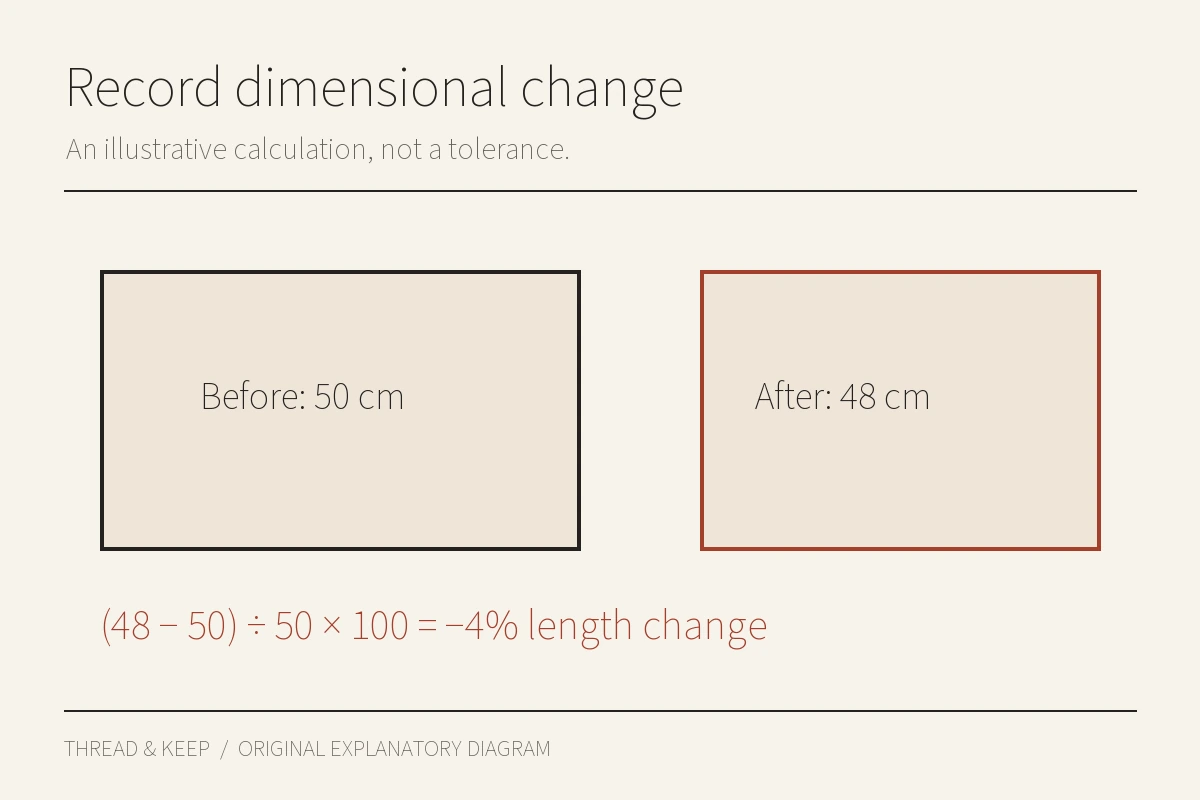
For an illustrative cover length of 50 cm before and 48 cm afterward, the signed change is minus 4 percent. Call that a 4 percent decrease in the recorded length. It does not establish that every part shrank by 4 percent or that a future wash will produce the same change.
If you prefer to report “shrinkage” as a positive decrease, state that convention explicitly. Do not switch sign conventions halfway through a comparison.
Worked example: tablecloth fit
Imagine a table 140 cm long and a cloth measured at 180 cm before care. Centered along that dimension, the nominal drop is 20 cm per end. If the dry cloth later measures 174 cm, the nominal drop becomes 17 cm per end.
That calculation helps decide whether the fit still suits your use. It does not tell you whether the original care was appropriate or supply a universal acceptable-change limit. Check the product’s own stated tolerances and instructions where available.
Stop before forcing a refit
If a cover strains its zipper or seams, do not stretch it around the insert simply to reproduce the earlier outline. Record the difference and contact the maker or a suitable repairer with the care history and photographs.
The most useful result is a comparable before-and-after record linked to a real fit decision. Keep missing evidence visible: if no before measurement exists, document the present state without inventing the original dimensions.