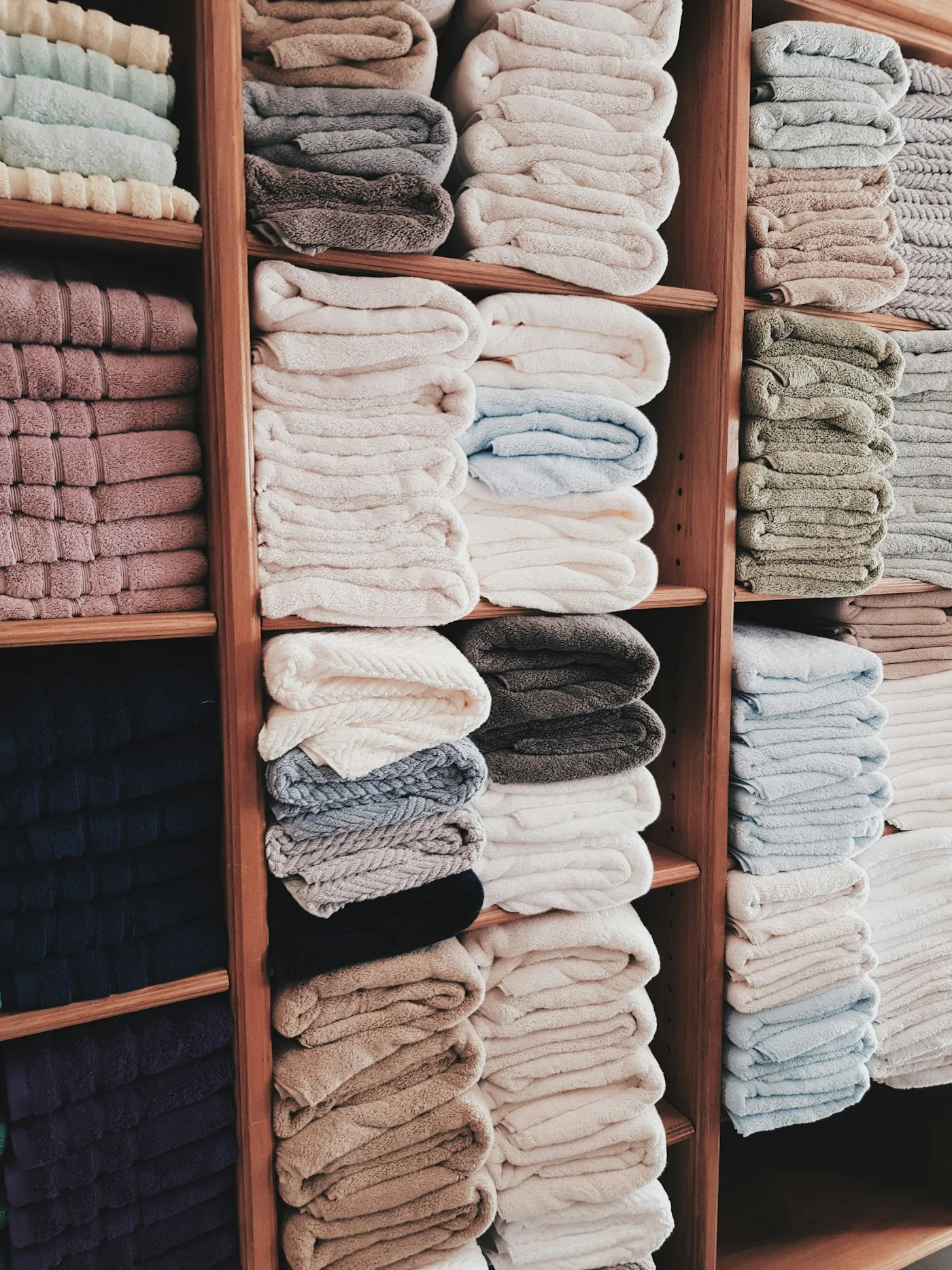
A linen cupboard can be full while still failing at its simplest job: providing a clean item that fits when you need it. The problem may be the wrong sizes, slow drying, inaccessible stacks or too many pieces that no longer serve a purpose.
Build the cupboard around actual use and laundry turnaround rather than a universal set count. A household with one bed, limited drying space and a weekly wash has different needs from one with several beds and frequent laundry. The useful quantity comes from that routine.
Inventory by destination first
Take one shelf at a time and sort the contents by where they are used. Identify the bed or mattress a sheet fits, the bathroom a towel serves and the table a cloth covers. Record dimensions where size names are ambiguous.
Separate usable pieces from those needing repair, a different use or disposal. A fitted sheet with tired elastic may still look tidy in a stack but fail when put on the bed. A towel kept only because it once belonged to a set is not necessarily useful reserve capacity.
Avoid discarding everything imperfect. A sound older towel can have a distinct cleaning role, provided you actually need it and store it separately. The point is to assign a real job, rather than relabeling every surplus item as an emergency spare.
Measure the return time
Notice how long an item is unavailable after use. Include the wait for a wash, washing itself, drying, folding and the delay before it returns to the shelf. Machine cycle time alone can underestimate the household turnaround substantially.
Use your normal routine as evidence. If laundry regularly waits until the weekend, count that delay. If a thick towel takes longer to dry in your room, do not plan the cupboard using an advertised drying time from another environment.
Unusual disruptions deserve a separate buffer decision. Occasional guests or a temporary drying problem may justify spare capacity, but they do not establish that every category needs the same number of extras. Choose the buffer consciously instead of accumulating it by default.
Use a simple rotation model
For a set-based item, distinguish what is in use, what is unavailable for cleaning and what remains ready. These are states in your routine, not mandatory purchase categories. One item can move through all three states over time.
For example, suppose one bed uses one sheet set, and the used set can be washed and completely dried before the next planned change. A second suitable set can cover the transition while the first is unavailable. If that turnaround repeatedly extends beyond the next change, either the routine or the reserve needs reconsideration.
This is an illustrative planning example, not a recommended minimum for all beds. Illness, children, guests, access to washing facilities and personal preferences can change the required capacity. Apply the same reasoning to your own observed schedule rather than copying the example's number.
Give clean items a safe return path
Inspect the cupboard before arranging it. It should be clean and dry, with no unresolved leak or persistent dampness. The Canadian Conservation Institute emphasizes storing textiles clean and dry and explains how unsuitable environments can damage them.
Let washed items dry completely before packing them closely. A surface that feels dry is not always the thickest fold or seam. Avoid using fragrance to conceal a musty smell; investigate the item and the space instead.
Create a place for newly returned laundry that does not require crushing an existing pile. That might be a modest clear section of shelf rather than a special organizer. The arrangement should work on a busy day when folding is functional rather than perfect.
Make retrieval easy enough to sustain
Keep everyday items within comfortable reach and less frequently used pieces farther away. Group sheet components by the bed they fit if that prevents repeated searching. Grouping every pale textile together may look coherent while making the practical job harder.
Use stack heights that allow a piece to be removed without dragging the whole pile out. Labels can help when several similar sizes are present, but the wording should identify a real destination rather than merely repeat a decorative category.
Do not force a bulky blanket into a space that compresses it heavily or traps a door against it. Review both the support needs of the textile and the available space. Valuable older linens may require a separate preservation approach rather than joining the ordinary rotation.
Review after a complete cycle
Run the arrangement through a normal laundry cycle before buying more storage accessories. Note what ran out, what never moved and which stack became awkward to use. Those observations reveal whether the issue is quantity, fit, turnaround or access.
Adjust one category at a time. If towels accumulate because they cannot dry properly, additional towels may hide the bottleneck without fixing it. If the same wrong-size sheet remains untouched, move it to a real alternative use or let it go.
The result should be a small, understandable system: pieces with known destinations, enough capacity for your actual turnaround and a dry, accessible place to return them. A cupboard that reliably supplies the next clean item is more useful than one organized around an arbitrary ideal photograph.