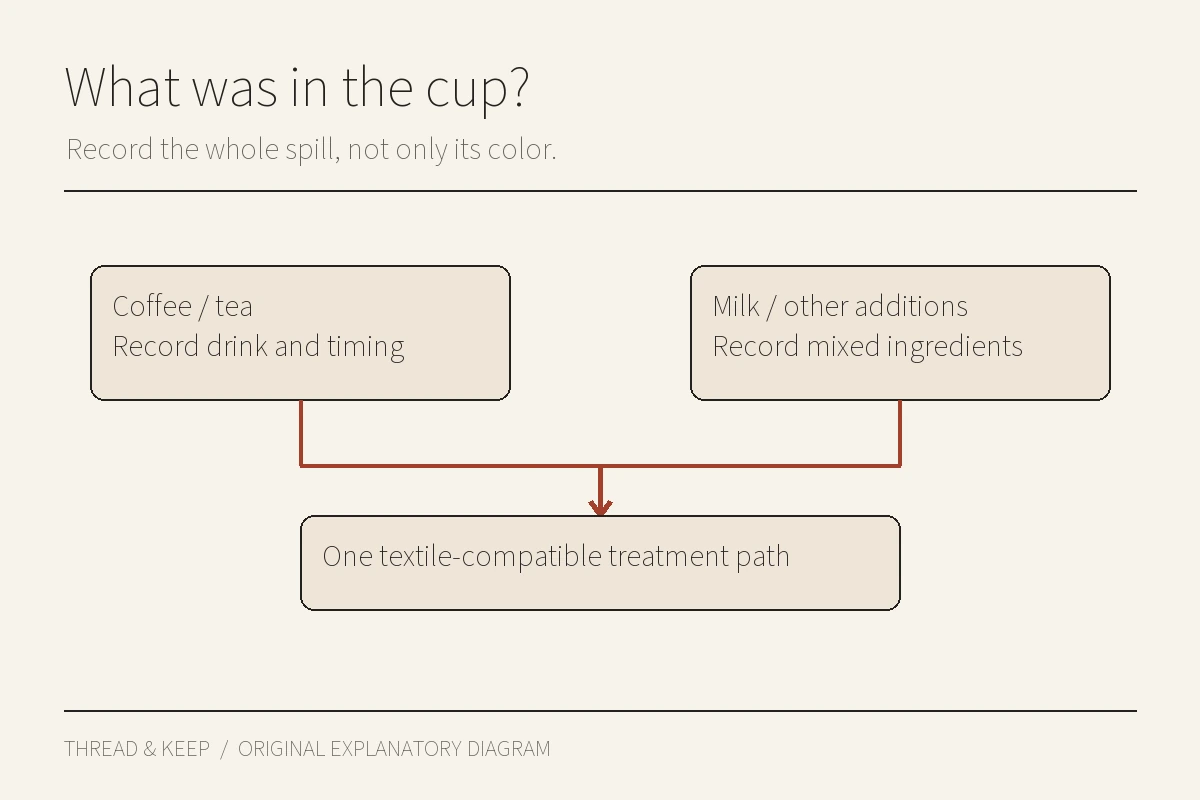
Coffee on a shirt is not always just coffee. Milk, cream, sweeteners and flavored syrups change what contacted the fabric, while dyes, finishes and trims change what the garment can tolerate. Start with that information rather than treating every brown mark as the same cleaning task.
This sequence is for ordinary garments that permit a suitable wet-cleaning process. It excludes antique textiles, fragile decoration and items with instructions that prohibit your proposed treatment. For those, preserve the facts and ask an appropriate cleaner.
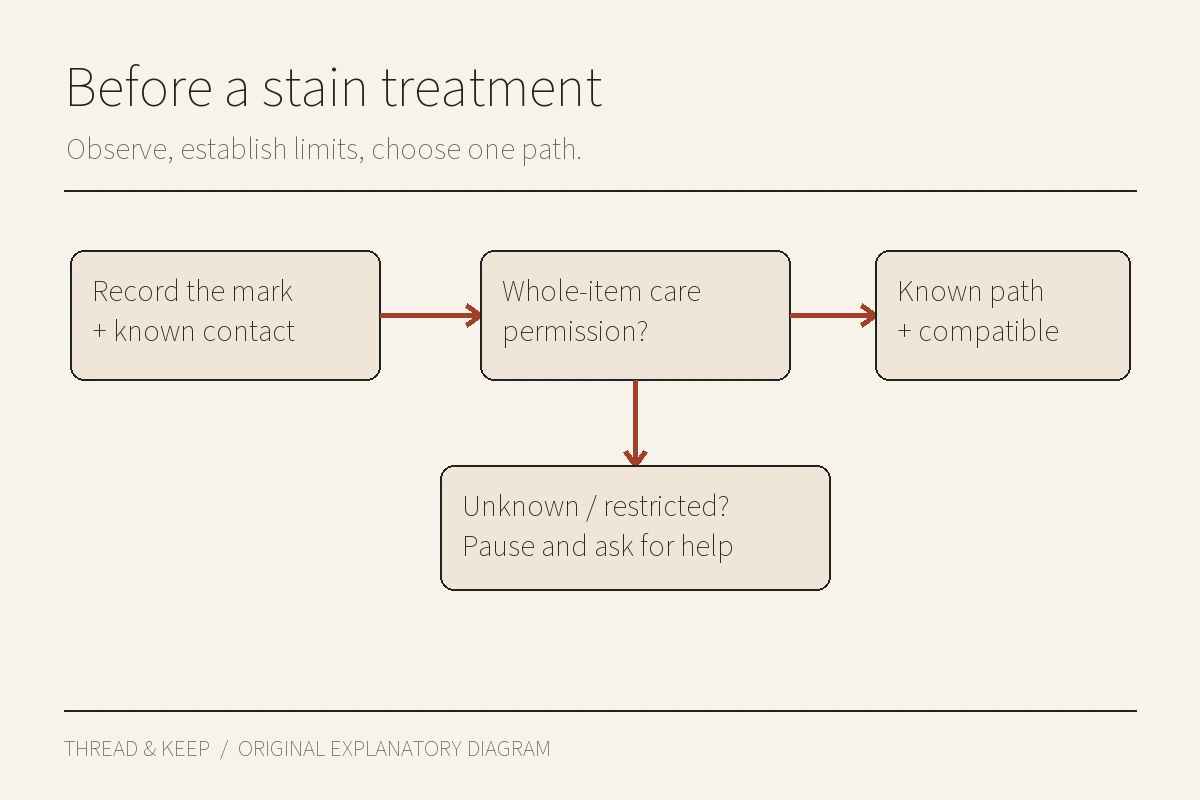
Record the drink and the treatment history
Note whether the drink was black, contained milk or included another ingredient. Record whether the spill is fresh, has dried naturally or has already gone through a dryer or iron. Do not rub or heat it simply to see whether it changes.
Support the area and gently take up loose liquid with clean absorbent material without spreading the spot. Avoid using a colored cloth that might introduce another source of dye. Check the lining and reverse if they are accessible without disassembly.
Establish whether wet treatment is allowed
Read the wash, bleach, drying and finishing instructions together. A pale color does not mean chlorine bleach is permitted. A “do not wash” instruction is not overridden by a coffee-stain recipe.
If the garment or product instructions are uncertain, stop before soaking. Ask a cleaner with the actual label and drink details. Valuable or sentimental textiles deserve that decision before a stain-removal experiment, not after several incompatible attempts.
Choose a product for the actual spill
The American Cleaning Institute gives separate advice for coffee or tea and for dairy products. Its coffee guidance includes cool-water treatment and a suitable pretreatment. Milk-containing drinks may also call for attention to the dairy component, but a product containing enzymes still needs to be suitable for the textile.
Use a laundry product whose directions address the stain and do not exclude the garment’s fibers or finish. Check the required dilution, direct application permission, contact time and rinsing. Do not leave a concentrated product on cloth while you search for the next recipe.
Follow one compatible path. Avoid adding vinegar, bleach or an unrelated cleaner to a wet pretreatment. A source describing several options is not an instruction to combine all of them.
Wash and inspect as two distinct stages
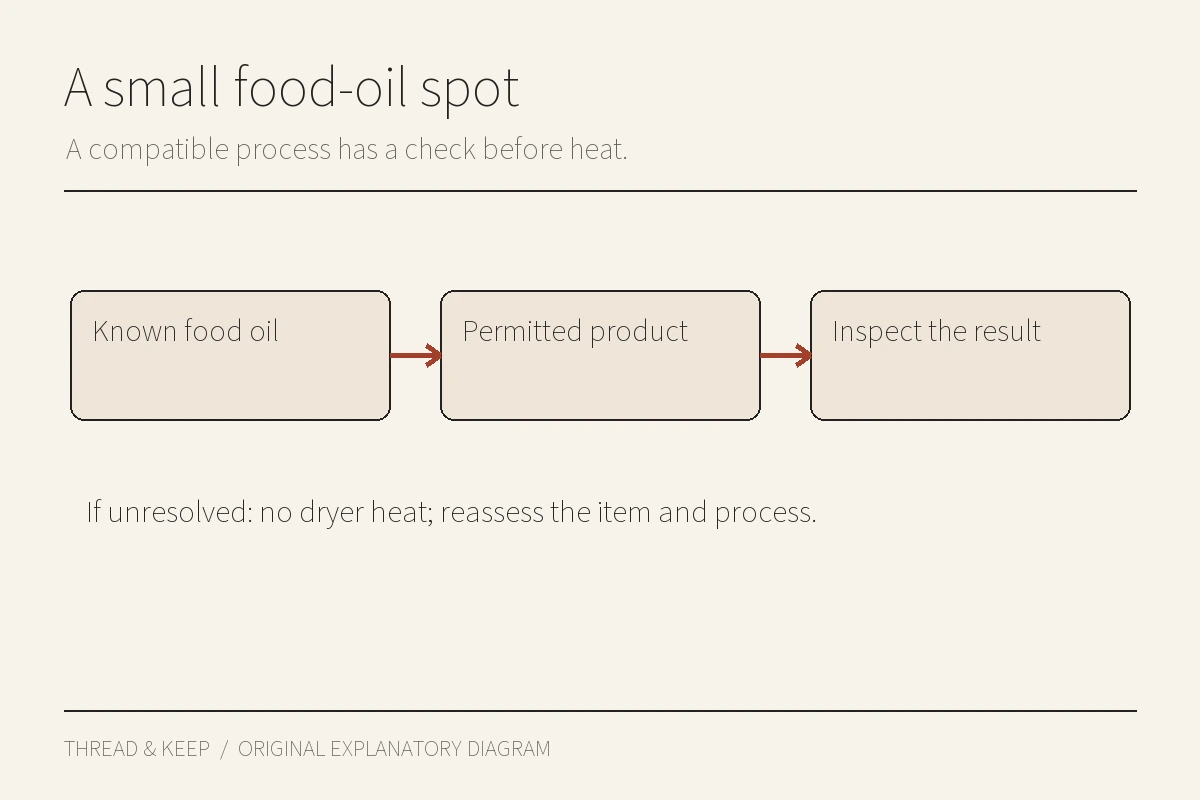
Choose the permitted wash program and product dose. Keep the temperature within the label ceiling and meet the mechanical-action restriction. The goal is a complete compatible process, not the highest setting that the machine offers.
Inspect the mark before tumble drying or ironing. Compare it in the same light, including its edge and any surrounding change. Use suitable permitted drying support if a dry view is needed. A wet dark patch can obscure what remains.
Worked example: a milky coffee ring
Imagine a washable shirt that has a pale brown ring after one documented process. Your record identifies a milk coffee spill and the exact product already used. The remaining ring does not prove that the dairy component or the drink color has been removed selectively.
If the product offers a compatible repeat step and the cloth is unchanged, that may be an option. If the label conflicts, the cause is uncertain or the surface has changed, stop. A useful handoff includes the original drink and the whole sequence rather than the conclusion “coffee remover failed”.
When to leave the remaining mark alone
Stop when treatment starts altering the base color, finish, texture or shape. Also stop when the next proposed product has no clear permission for the item. Appearance alone cannot tell you that more aggressive cleaning is safe.
Keep the photographs and notes. They make a professional assessment easier and help avoid repeating an unsuccessful process. No percentage improvement or guaranteed removal time can be inferred from the color of a ring on an unfamiliar fabric.