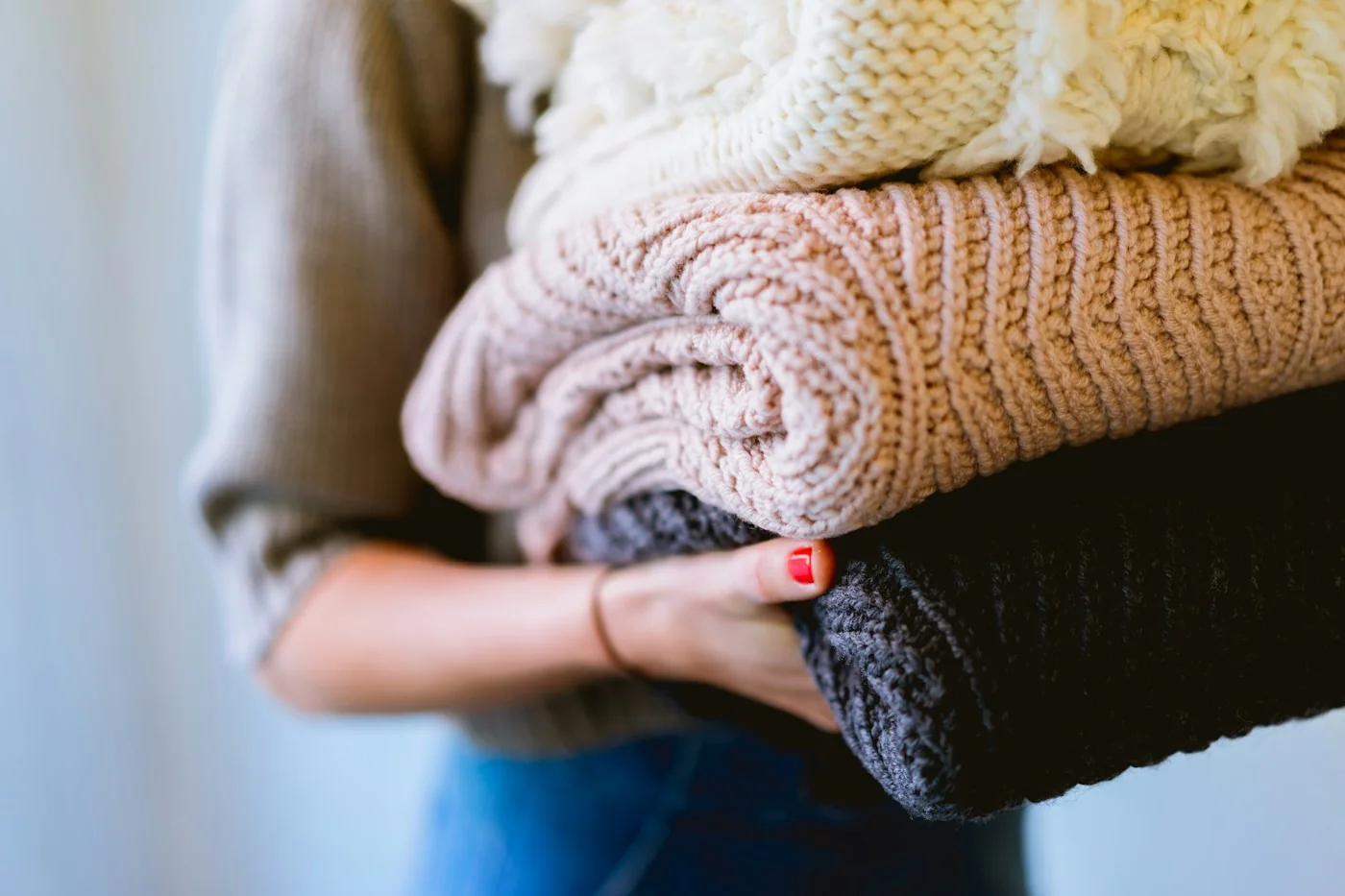
The wash has finished, and a heavy sweater is waiting in your hands. Hanging it seems efficient, but drying is also a question of support. Water adds weight, and the way that weight travels through the garment can change its shape before it is dry.
Choose the drying arrangement before washing whenever possible. A suitable process needs enough space, a compatible surface and time for the whole item to dry. It should follow the finished garment's label rather than a general rule based only on the main fiber.
Find the actual drying instruction
Read both written directions and the drying marks on the label. Washing permission does not imply permission to tumble dry, hang in sunlight or drape over a radiator. GINETEX separates drying instructions from the washing process for that reason.
Check for a flat-drying requirement, a hanging arrangement or a shade restriction. If a symbol is unfamiliar, consult the correct symbol system rather than treating every square mark as interchangeable. A missing label leaves uncertainty that a quick fiber guess cannot resolve.
Woolmark recommends flat drying for wool knitwear unless the care claim allows a different method. Its guidance also distinguishes some woven wool garments that can be supported on a hanger. That does not establish that every lined or tailored woven item is suitable for the same treatment.
Prepare somewhere the garment can rest
For permitted flat drying, use a clean, appropriately sized surface that supports the item without letting sleeves or heavy sections hang over an edge. A suitable drying mesh can allow air movement while supporting the cloth.
Woolmark also describes a pale, lint-free towel as a support. Make sure the towel itself is clean and does not introduce unwanted fibers or dye. Avoid a surface whose coating or unfinished material could transfer to a damp garment.
Leave room around the drying area. Placing another wet item directly on top does not create useful capacity. Keep the setup away from direct heat and any location where pets, rough hardware or repeated handling could disturb the cloth.
Move wet fabric with its weight supported
Do not lift a water-heavy knit by the neckline or one sleeve. Gather and support its body so the load is not concentrated in a small section. If the washing instructions call for a particular extraction method, follow it rather than improvising vigorous wringing.
Transfer the garment onto the prepared support and unfold it gently. Check that a sleeve is not twisted underneath or pulling on the shoulder. Keep fastenings and trims from pressing sharply into another part of the cloth.
If the item is too large or heavy to handle comfortably, arrange assistance before washing it. A blanket that exceeds your available support space is not solved by treating one corner as a lifting handle. The whole process has to fit the equipment and space available.
Shape gently without forcing a size
Arrange the garment into its natural outline, smoothing obvious folds without stretching the cloth. Align seams where practical. The aim is to let it dry in a reasonable resting shape, not to pull it toward a desired size with force.
A familiar measurement or an earlier photograph can help reveal distortion, but it does not justify aggressive stretching. Shrinkage can have different causes, and some changes cannot be reversed. Avoid promising that blocking or damp reshaping restores every altered garment.
Take care with thick edges, cuffs and pockets. These sections may remain wetter than the body. Arrange them so they are supported and not tightly doubled into an unnecessarily dense bundle.
Give air a route through the setup
Drying depends on more than the label's method. Air movement, room conditions, garment thickness and how the support holds moisture all affect the time needed. There is no reliable universal drying time for all sweaters.
Check the underside and the supporting towel as the item dries. If a towel has become very damp, replacing it with a suitable dry one can prevent the garment from sitting on retained moisture. Support the item during that change rather than lifting it from a narrow edge.
Do not move the garment onto a radiator to finish a slow section. Woolmark warns against direct heat and strong sunlight when drying wool. More intense treatment is not necessarily a safe substitute for adequate time and a better arrangement.
If hanging is permitted, inspect the contact points
Use the specific arrangement allowed by the label. A hanger should support the intended shape, while a line or rack can concentrate weight at its contact edge. Consider how pegs, clips or narrow rods might mark or distort the material.
Keep components from pulling unevenly as they dry. A heavy pocket or lining can make a garment hang differently from its dry state. Recheck alignment rather than assuming a straight-looking hanger guarantees a straight garment.
Before storage, inspect the thickest folds and seams, not only the exposed surface. Let the item finish drying completely. A good drying setup ends with a sound, dry garment that is ready for use or storage; it does not end merely when the most visible panel feels dry to your fingertips.